Introducing EAGLEi: Continuous threat exposure management for healthcare
Stop managing vulnerabilities. Start eliminating them!
Most security providers identify vulnerabilities. EAGLEi helps eliminate them.
Healthcare IT teams are constantly balancing operational demands, cybersecurity risks, and limited resources.
Finding vulnerabilities is only the beginning. The real challenge is knowing which ones pose the greatest risk — and having the resources to resolve them.
EAGLEi continuously identifies the exposures that matter most, automatically remediates up to 70% of common vulnerabilities, and helps your team focus on the issues that require human expertise.

- Continuously scans every 4 hours and identifies where you’re most exposed.
- Prioritizes what needs fixing and automatically resolves many of them.
- Supports your team with highly credentialed 24/7 cybersecurity expertise
- Measures and reports how cyber risk is reducing over time.
Why healthcare organizations need continuous threat exposure management.
Healthcare organizations rely on technology to deliver safe patient care.
- If emergency departments lose access to critical systems, treatment gets delayed.
- If medical devices become unavailable, clinicians have fewer options.
- If clinical systems go down, care slows down.
When cyberattacks succeed, the consequences reach every part of your organization.
Doctors and nurses are locked out of patient records
forcing them to make decisions without seeing medications, allergies, or medical history.
Emergency departments start diverting patients
because the systems needed to transport, assess, admit, and treat them aren’t available.
Clinical teams return to paper-based processes
increasing the risk of mistakes while creating weeks or months of recovery work.
Sensitive patient data is exposed
triggering regulatory action, legal claims, financial penalties, and a loss of patient trust.
Critical systems and medical devices go offline
delaying diagnosis, surgery, and other time-critical care.
- The challenge is that healthcare environments never stand still.
New medical devices are connected. Suppliers need remote access. Hospitals expand. Systems are upgraded. AI tools start appearing in departments. Every change creates another potential way into your organization.
The bigger and more connected your environment is, the harder it is to know which risks matter most and what needs fixing first.
Continuous Threat Exposure Management (CTEM) helps you answer those questions.
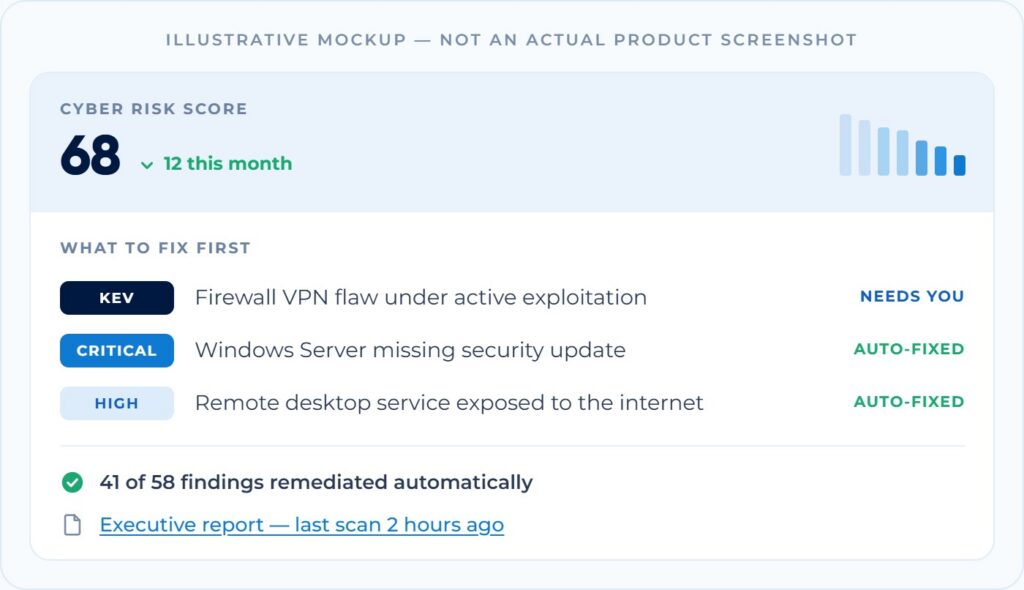
It continuously identifies where you’re most at risk, prioritizes what attackers target, and helps you reduce cyber risk before it disrupts patient care.
Identify your biggest cyber risks. Know what to fix first.
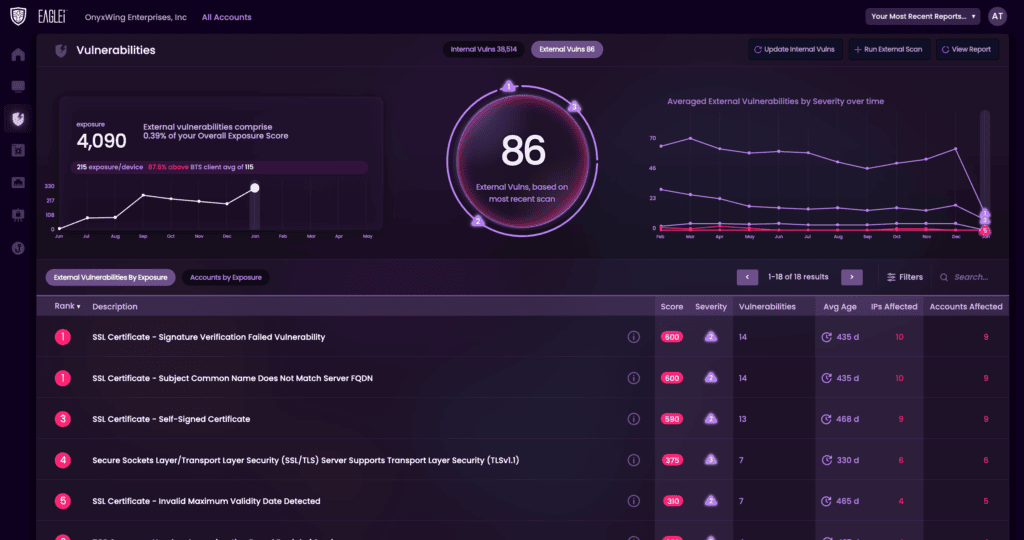
EAGLEi is a managed Continuous Threat Exposure Management (CTEM) service from Black Talon Security. It combines enterprise security technology, 24/7 cybersecurity expertise, remediation support, and executive reporting into one managed service.
Most healthcare organizations already know that cyber risk is increasing. The difficult part is understanding the highest risks and working out what to pay attention to first.
EAGLEi gives you the answer.It brings together your security data, highlights what matters most, helps resolve common issues automatically, and gives your team expert support when something needs a human investigation.
See how EAGLEi brings cyber risk into a single pane of glass and helps your team understand what needs attention first.
Common healthcare exposure risks.
Even well-managed healthcare organizations develop blind spots over time. New systems are connected, software changes, suppliers need access, and new vulnerabilities emerge every day..
These are some of the most common ways cyber risk builds unnoticed.
01
Known Exploited Vulnerabilities (KEVs)
Your IT team reviews firewall updates, VPN patches, Windows servers, VMware hosts, medical devices, and hundreds of third-party applications.
Some can be installed right away. Others have to wait because clinics are running, systems need testing, or devices can’t be taken offline.
Most of those vulnerabilities aren’t being actively exploited. Known Exploited Vulnerabilities (KEVs) are different. They’re security flaws attackers are already using to break into organizations, which means they should move to the top of the list.
- SCENARIO
02
Shadow IT and Unknown Assets
Not every application, device, or supplier enters your environment through IT.
A consultant starts using an AI scribe. Radiology connects a new imaging system. A pathology supplier needs remote access to support laboratory equipment.
If IT doesn’t know something exists, it can’t secure it.
- SCENARIO
03
Security Gaps Between Assessments
Security assessments only tell you what your environment looked like on the day they were carried out. The next day, firewall rules are changed. A new web application goes live. A server is moved to the cloud. Someone opens a port to fix an urgent problem and forgets to close it again.
Those changes can introduce new security gaps, but they’re often not discovered until the next assessment.
- SCENARIO
Everything your team needs to stay ahead of cyber risk.
From identifying cyber risks and stopping attacks to helping your team remediate issues and demonstrate risk reduction progress, EAGLEi brings everything together into one managed service.
Endpoint Protection

Stops ransomware and other threats before they spread across laptops, servers, and clinical systems.
Vulnerability Management

External Attack Surface Management
Endpoint Protection
Incident Response Support
Helps you investigate attacks, contain the threat, recover systems, and get clinical services back online.
Security Awareness Training
Penetration Testing
Shows you the systems attackers can already see on the internet, so you can secure them before hackers find and target them.
Endpoint Protection
Most security tools tell you where you're vulnerable. EAGLEi helps you fix & reduce the risk.
Most managed security providers tell you something needs attention. They send alerts, generate reports, and identify vulnerabilities.
That’s useful. But your team still has to work out what matters most, decide what to fix first, and prove cyber risk is actually going down.
EAGLEi works differently. Instead of giving you another list of problems, it helps you resolve them. It highlights what matters first, automates common remediation, and supports your team until the job is done.
Traditional MSSP/MSP
- Monitors alerts Tells
you when something looks wrong. - Generates vulnerability reports for your team to work through.
- Identifies and prioritizes security weaknesses and vulnerabilities across your environment.
- Responds when incidents happen
Helps investigate and respond after threats are detected. - Works to a schedule
Regular scans and periodic reviews show how things looked at a point in time. - Focused on today’s cyber risks
Traditional security monitoring.
EAGLEi
- Identifies where you’re most exposed
Continuously identifies the systems, vulnerabilities, and exposures attackers are most likely to target. - Automatically remediates up to 70% of common vulnerabilities
without human intervention. - Supports remediation so issues are resolved — not just reported or prioritized.
More complex, Known Exploited Vulnerabilities (KEVs) are identified for immediate human attention. - Works to prevent incidents from happening
Continuously reduces exposure to lower the likelihood of successful attacks. - Works continuously
EAGLEi scans your environment every 4 hours or 6 times every 24 hour period. - Ready for tomorrow’s AI risks
Up to 70% of vulnerabilities can be remediated automatically.
Not every vulnerability needs an engineer.
Real situations. Real risks. Real results.
Every healthcare organization has blind spots, stretched resources, and growing complexity. Here’s how EAGLEi helps you stay ahead.
You’ve just inherited an entire hospital network overnight
The acquisition is complete, the network is connected, and the security questions are just beginning. You don’t know what systems you’ve inherited, what’s internet-facing, or whether any of it has already been compromised.
Now you’re responsible for securing an environment you’ve never properly assessed.
See how EAGLEi discovers and inventories healthcare assets →
Clinical workstations are running outdated software, but nurses rely on them
The acquisition is complete, the network is connected, and the security questions are just beginning. You don’t know what systems you’ve inherited, what’s internet-facing, or whether any of it has already been compromised.
You still need to know whether they’re vulnerable, if attackers could reach them, and how to reduce the risk without interrupting patient care.
Hospital staff are using unapproved AI to save time
A hospital manager uses AI to summarize multidisciplinary team meetings. Nurses use it to draft patient discharge summaries. Clerks use it to draft patient letters.
Patient information is now being copied into AI tools IT hasn’t reviewed, approved, or secured.
IT is covering three hospitals with six people
Most days are spent resetting accounts, fixing printers, supporting clinicians, and keeping systems online.
Finding time to work through thousands of security findings simply isn’t realistic.
A phishing email nearly shut down the emergency department
Someone clicked the link. The attack was stopped before it spread, but appointments were delayed while systems were checked and restored.
Next time, you don’t want to rely on catching the attack after it’s started. You want to stop a single click becoming a major incident.
Ransomware has locked clinical staff out of the patient record system
Staff arrive for the morning shift and can’t access patient records. Appointments are starting, clinicians need medication histories, and nobody yet knows how far the attack has spread.
Your team needs to contain the attack, understand what’s been affected, and get critical systems safely back online before the situation becomes worse.
Your provider network has multiple sites. None use the same systems.
Each hospital, centre, and clinic in your network has different security tools, infrastructure, and suppliers.
Finding the alerts that genuinely matter means jumping between dashboards and piecing the information together yourself.
A cyberattack makes the headlines. The board wants reassurance.
Another hospital has been brought to a standstill by ransomware. Now the board wants to know whether the same thing could happen here.
They need evidence that cyber risk is being identified, prioritized, and reduced.
Cyber risk is changing.
AI risk is evolving even faster
EAGLEi helps healthcare organizations continuously identify, prioritize, remediate, and monitor cyber exposures through a managed Continuous Threat Exposure Management (CTEM) program.
As AI adoption accelerates across healthcare, organizations face a new challenge: understanding where AI is being used, who is using it, and whether its use aligns with internal policies, security requirements, and regulatory obligations.
For organizations that want to manage both, Aura AI extends EAGLEi’s capabilities into AI governance. It helps identify AI adoption across the enterprise, reduce Shadow AI, and supports AI governance and compliance from the same trusted security partner.
WORKS TOGETHER
One partner. One continuous approach.

Endpoint Protection
Continuous cyber risk management
Continuously identifies, prioritizes, remediates, and monitors cyber exposures across your environment.
Aura AI
AI governance and oversight
Extends visibility into AI adoption, Shadow AI, AI governance, and compliance.
Aura AI provides the visibility, governance, and operational controls needed to scale AI responsibly.
Aura AI helps healthcare organizations understand where AI is being used, manage Shadow AI, and govern AI use alongside their existing cybersecurity programs.
EAGLEi strengthens the security team you already have.
Whether you’re the only person looking after IT or leading an established security team, with EAGLEi, you spend less time working out what needs attention and more time reducing cyber risk.
It works alongside your existing security tools, helps you focus on what matters first, and gives you extra support when you need it.
One IT manager doing everything
You’re keeping systems running, supporting staff, fixing printers, resetting passwords, and trying to stay on top of security.
Growing healthcare organizations
Dedicated security teams
Works with your existing security investments
You’ve already invested in cybersecurity. EAGLEi doesn’t ask you to replace it.
Instead, it brings your existing tools together, helps you focus on what matters most, and adds the expertise needed to keep reducing cyber risk over time.
See where your greatest cyber risks are today and eliminate them!
Every healthcare organization has exposures, and any security vendor can generate a list of vulnerabilities. The real question is: who will help you eliminate them before an attacker exploits them?
Book a live demo to see how EAGLEi helps you identify, prioritize, and reduce cyber risk continuously.
FAQs
Questions healthcare leaders ask.
What is EAGLEi?
EAGLEi is a managed cybersecurity program from Black Talon Security that helps healthcare organizations continuously find, prioritize, and reduce cyber risk. It combines enterprise security technology, 24/7 cybersecurity experts, remediation support, and executive reporting into one managed service.
What cybersecurity services are included in EAGLEi?
EAGLEi includes endpoint protection, vulnerability management, external attack surface management, managed detection and response (MDR), incident response support, penetration testing, security awareness training, and executive reporting. There’s also an add-on option for AI governance for risk & compliance through Aura AI.
Is EAGLEi designed for healthcare organizations?
Yes. EAGLEi is built specifically for hospitals, health plans, multi-specialty clinics, imaging centers, and physician practices.
Whether you have a small IT team or a dedicated cybersecurity function, it helps you continuously understand where you’re most exposed and what to focus on next.
Do I need to replace my existing security tools?
No. Most healthcare organizations already have security tools in place. EAGLEi is designed to work alongside your existing security investments, bringing together the technology, expertise, and ongoing support needed to continuously reduce cyber risk.
Will EAGLEi replace our IT or security team?
No. EAGLEi is designed to strengthen the team you already have.
It automates many routine remediation tasks, helps prioritize what matters most, and provides expert support when it’s needed, so your team can focus on higher-value work.
What is Continuous Threat Exposure Management (CTEM)?
Why do healthcare organizations need CTEM?
Healthcare organizations are constantly changing. New clinics open, systems are upgraded, suppliers need access, and new vulnerabilities are discovered every day.
CTEM helps you keep up with those changes by continuously identifying where you’re most exposed and helping you reduce risk before attackers have the chance to exploit it.
How does EAGLEi reduce cyber risk?
Can EAGLEi work across multiple hospitals or clinic locations?
How do EAGLEi and Aura AI work together?
EAGLEi and Aura AI help healthcare organizations manage cyber risk and AI risk together.
EAGLEi provides Continuous Threat Exposure Management (CTEM) to help healthcare organizations identify, prioritize, remediate, and monitor cyber risk.
Aura AI provides AI governance, helping organizations discover AI use, reduce Shadow AI, and manage compliance risks. Together, they give healthcare leaders a comprehensive view of both cybersecurity and AI-related risk across the organization.
Should I use both EAGLEi and Aura AI?
If your organization needs to manage both cybersecurity and AI risk, EAGLEi and Aura AI can work together. EAGLEi helps reduce cyber exposure across your environment, while Aura AI helps you identify, manage, and govern AI use.